Why We Flat Tow

When we first started seriously looking at RV travel back in 2014 and 2015, the first decision wasn't how we would tow a vehicle. It was what kind of RV made the most sense for the way we wanted to travel.
We looked at bumper-pull trailers, fifth wheels and motorhomes.
A fifth wheel gives you a lot of living space, but a larger one also requires a pretty substantial truck to pull it. Then, when you arrive somewhere and unhitch, that three-quarter-ton or one-ton pickup becomes your everyday transportation. We didn't particularly want to spend our sightseeing days, grocery runs and trips through national parks driving a big tow vehicle.
We also knew we didn't want something as small as many travel trailers.
That gradually pushed us toward a motorhome. We liked the idea of having the living space, storage and conveniences we wanted in something we could simply get in and drive.
That solved one problem and immediately created another.
Once you park a motorhome at a campground, your house is parked too. You don't want to break camp every time you need groceries, want to go out to eat or decide to spend the afternoon exploring a national park.
So we knew we were going to need another vehicle traveling with us.
Then came the next question: How do we bring it along?
There are several ways to tow a vehicle behind a motorhome. You can put it on a flatbed trailer, use a tow dolly, or use some much larger arrangements. My brother Fred even had a stacker trailer that used hydraulics to carry two vehicles.
I spent a lot of time researching the choices and eventually decided that flat towing — pulling the vehicle with all four wheels on the ground — made the most sense for us.
That decision affected what vehicle we bought.
Before we even bought our first motorhome, Phyllis, we bought a new 2016 Chevy Colorado. One of the major reasons was that the Colorado could be flat towed.
That's an important part of the equation because you can't simply put a tow bar on any vehicle and drag it down the road. The vehicle has to be designed so the drivetrain can be placed in the proper condition for flat towing. Many vehicles can't be flat towed at all without risking serious drivetrain damage.
The tow bar itself is actually the easy part. It slides into the receiver hitch on the motorhome.
Most of the work happens on the vehicle being towed.
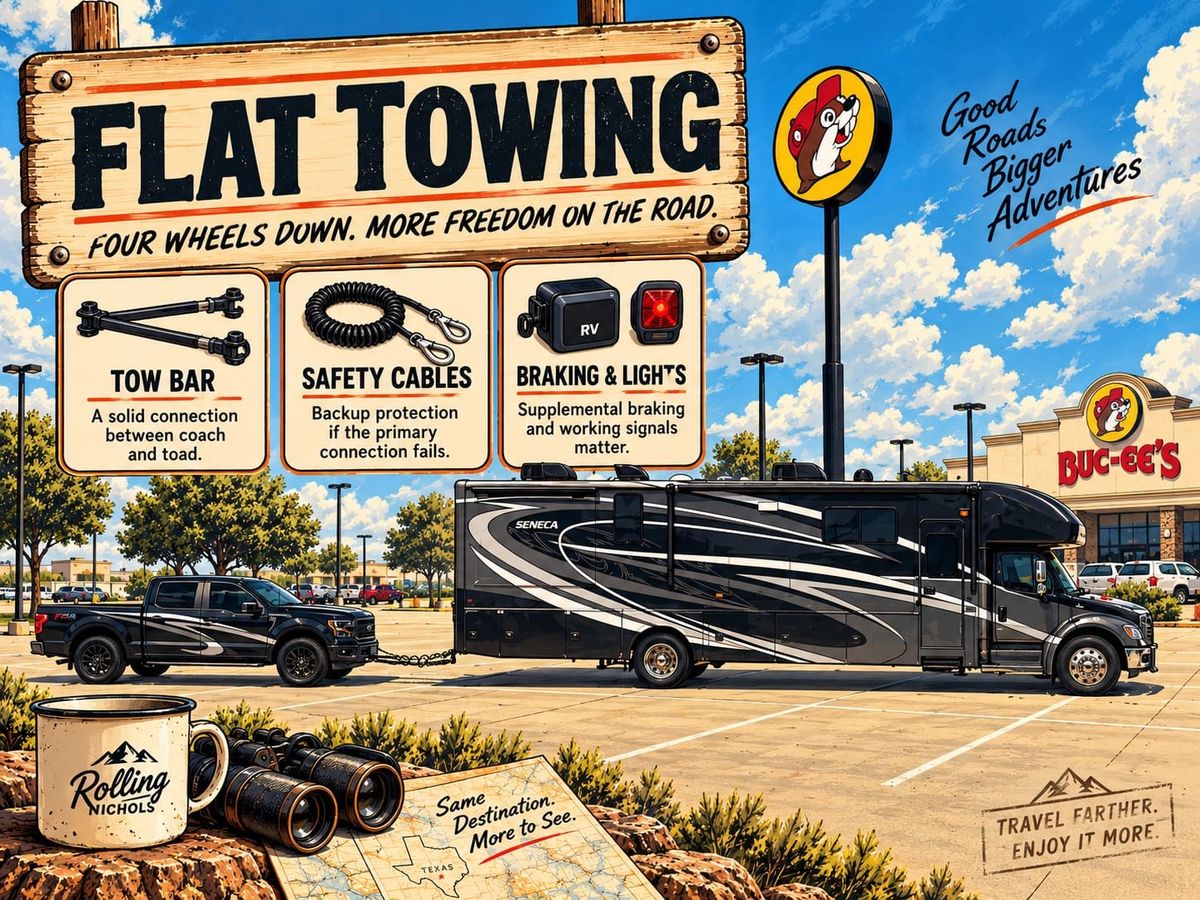
On our Colorado, the front end had to be disassembled so a baseplate could be installed underneath it. Wiring had to be run back to the lights, and connections were added for the tow bar, safety cables, electrical system and supplemental braking system.
There was another issue that isn't nearly as obvious: the battery.
When you're towing all day, the vehicle isn't running, so its alternator isn't replenishing the battery. Depending on the vehicle, leaving its electrical systems connected can eventually leave you with a dead battery when you arrive.
On the Colorado, I had a marine-style battery cutoff switch installed. Once the drivetrain was placed in the proper towing configuration, I'd open the hood and disconnect the battery from the vehicle. When we arrived, the process was simply reversed.
I've run into other RVers who learned that lesson the harder way. More than once I've seen someone at a fuel stop with a battery charger connected to their tow vehicle. The last time was at Costco, where I ended up explaining how we had solved the problem on the Colorado.
Technology has moved along since then.
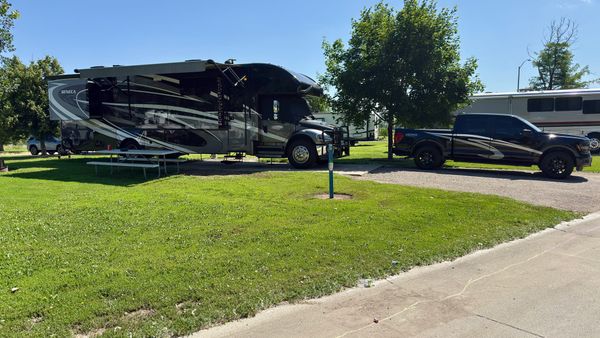
With Vern, our F-150, much of the process is handled through the truck itself. While I'm outside doing the physical hookup, Lisa usually sits in the driver's seat and works through the flat-towing procedure. The truck goes into its proper neutral-tow configuration and handles the electrical shutdown required for towing.
Once the vehicle itself has been properly set up, the actual hookup is surprisingly simple.
Two tow-bar arms extend from the motorhome and connect to removable attachment points on the truck. We connect the electrical cable, safety cables and braking system, check everything, and we're ready to go.
After doing it for years, Lisa and I can usually hook up or disconnect in about five minutes.
There is one limitation that changes the way you drive a motorhome with a vehicle behind it:
You can't back up while you're flat towing.
That sounds like a bigger problem than it usually is.
You learn to think ahead. Before I pull into a fuel station, parking lot or other tight area, I'm already looking at how I'm going to get back out. A dead end or a poorly designed parking lot matters a lot more when you're roughly 65 feet long and reverse isn't an option.
It becomes second nature after a while.
In roughly ten years of traveling this way, I've only had to disconnect the tow vehicle twice because I got myself into a situation I couldn't drive out of.
Flat towing isn't the only way to bring another vehicle along, and it isn't the right answer for everyone.
But after looking at the alternatives and then living with the decision for years, it's still the system that works best for the way we travel.