Driving 65 Feet

The most important thing we’ve learned about driving a big RV has very little to do with its size.
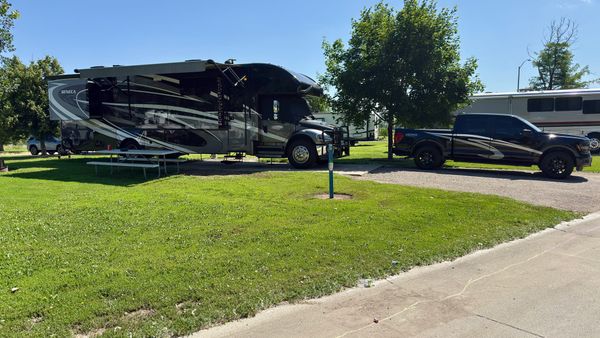
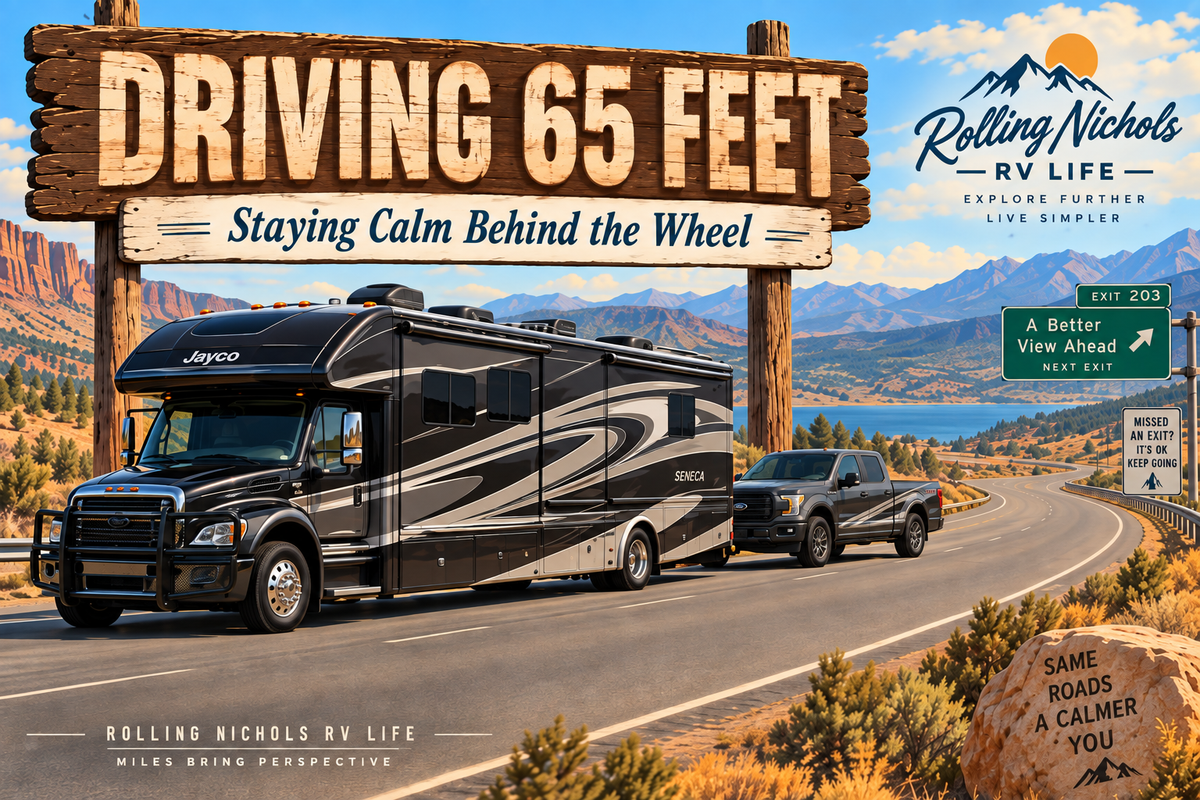
Many people see Harriet and Vern in a picture—or sometimes in person—and are a little overwhelmed by how long we are. I measured the combination at roughly 65 feet.
That sounds intimidating to a lot of people. I suppose it would have sounded intimidating to me too if I hadn’t worked my way up to it over the years.
I didn't start out as an experienced big-rig driver. Everything I know started with our first RV and gradually grew from there.
And probably the most important thing I could pass along about driving an RV applies whether you’re in a motorhome, pulling a travel trailer, or towing a fifth wheel:
Don’t force the situation.
That sounds simple. It isn’t always.
There Is Always Another Exit
On our return maiden trip with Harriet, we were coming into Kerrville, Texas, heading east on I-10.
I want to say we were supposed to take Exit 501. You come over a rise, and the exit is partway down the other side.
Lisa and I were talking. I wasn’t paying enough attention to the Garmin, and by the time Lisa yelled, “There’s our exit,” I hadn’t started slowing down.
I could have tried to force it.
Brake hard. Move over. Make the exit.
Instead, I kept going.
Experience has taught me that staying calm is paramount. There is always another exit. There is always someplace to turn around. There is almost always a way to recover from a missed turn.
What causes trouble is the knee-jerk reaction when somebody suddenly decides they have to make that exit.
You don’t.
One of the best things you can get into your head while driving an RV is that there is simply no reason to take that risk.
Leave Yourself Room
The other thing you learn very quickly is to be hyper-aware of the traffic around you.
People driving everyday vehicles sometimes seem to assume Harriet stops just like they do.
She doesn’t.
In bumper-to-bumper traffic, I’ll intentionally leave space in front of me. Of course, that creates another problem: somebody invariably decides I left that space specifically for them to change lanes.
So they pull in.
And I back off again.
Then somebody else sees the new opening.
It can make a traffic jam a little tedious.
But I would rather continually rebuild my stopping distance than spend the entire time six feet off somebody’s bumper.
There’s a mindset that helps:
You’re driving your home. There’s no hurry to get anywhere. You’re already at home.
The Bigger Fuel Tank Created a Different Problem
Our first RV had about a 50-gallon gasoline tank.
That meant we stopped fairly often. I generally like to start thinking about fuel around half a tank because I never want to find myself wondering where the next fuel opportunity will be.
We’ve also written about how we buy diesel on the road.
Those fuel stops had an unintended benefit.
They made us get out of the RV every few hours.
Harriet is different.
She carries about 100 gallons of diesel, and at roughly 8 miles per gallon, we can theoretically travel around 800 miles on a tank.
We would never intentionally drive that far in a day, but having that range makes it surprisingly easy to forget to stop.
We learned that early on.
After one particularly long stretch of driving, Lisa and I realized we had been sitting in the cab for something like six hours.
When we finally stopped, getting out of the cab reminded us that neither one of us was 25 anymore.
Since then, we try to stop every two to three hours, whether we need fuel or not.
Our Travel Days Have Found Their Own Rhythm
No matter how hard we try to leave an RV park early, we seem to pull out at about 10:30 in the morning.
We’ve mostly stopped fighting it.
That gives us a relatively short first driving stretch. Then we stop somewhere for lunch, get out of the cab for a while, and reset.
After lunch, following our Rule of Threes as closely as practical, the next stop is often our destination for the night—or somewhere we’re staying for several days.
It isn’t the fastest way to travel.
That’s fine with us.
We’re Already Traveling
This may sound strange, but it’s probably the biggest change in how we think about RV travel.
The trip isn’t something we have to get through before the vacation begins.
The trip is part of the vacation.
The rest area where we make lunch, the small town we unexpectedly drive through, the scenic pull-off we weren’t planning to stop at, and even the occasional missed exit are all part of traveling.
The destination matters.
But so does everything between destinations.
And when you’re driving something 65 feet long, weighing many tons, with your home sitting directly behind your seat, there is almost never a good reason to hurry.