Make Leaving Easier

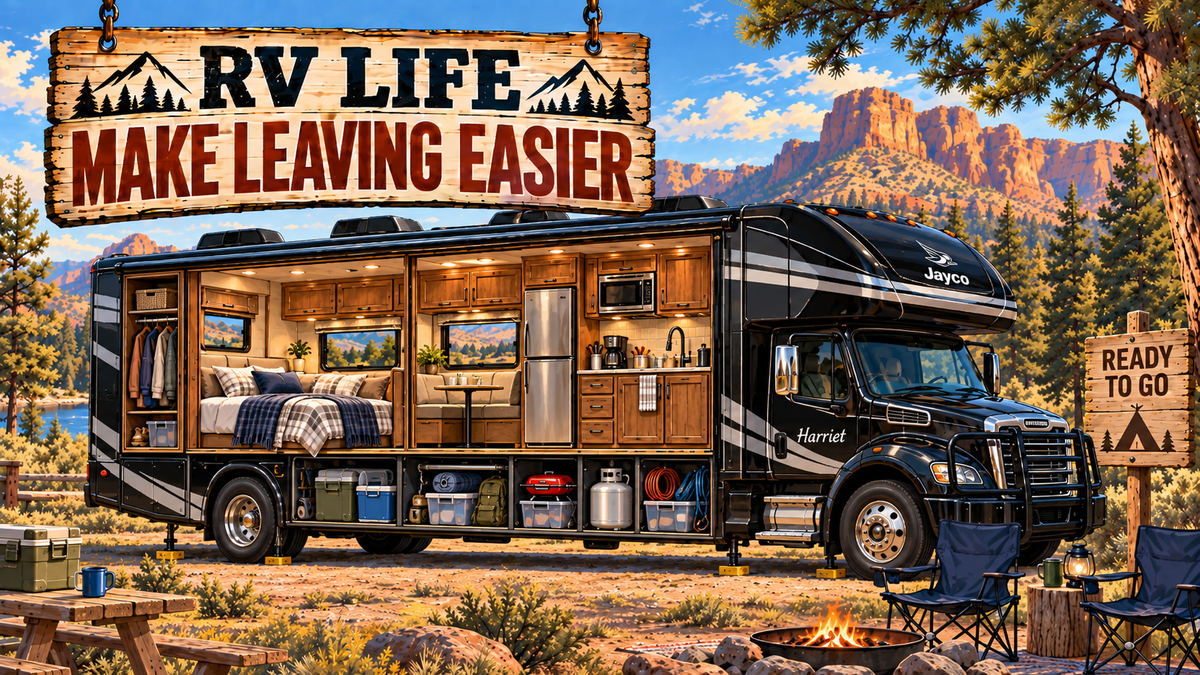
When we first started RVing, getting ready for a trip felt like a project.
Whether we were leaving for two days or an extended trip, we spent an inordinate amount of time loading the RV. Clothes went back and forth. Refrigerator staples had to be moved. Kitchen gear had to be gathered. Camping chairs had to be remembered. Then there were all the little things that seem insignificant until you are 200 miles from home and realize you left one behind.
And this is where it can really become a problem.
If you spend three or four days getting ready for a two-day weekend at a state park, eventually the preparation starts to outweigh the trip.
That gets old quickly.
The harder it is to get out the door, the easier it becomes to say, “Maybe next weekend.”
And that is how RVs and travel trailers start sitting instead of being used.
It took us a while to understand that we were approaching it the wrong way.
The goal should not be to pack your RV every time you leave.
The goal should be to set up your RV so leaving is easy.
Start With the Things You Use Every Day
One of the simplest lessons we learned was to duplicate the things we use constantly.
If you have a specific brand or style of jeans you wear all the time, buy another pair or two and leave them in the RV.
Do the same with underwear, socks, shoes, T-shirts, sweatshirts, and other everyday clothing.
My wife and I each have a particular type of blanket we sleep with at home. We have the exact same blankets in the RV.
That may sound like a small thing, but it means those blankets never have to be packed, unpacked, forgotten, or carried back and forth.
They are simply there.
That is the idea.
Make the RV Feel Familiar
Your RV should mimic your normal life at home as closely as practical.
Not your house.
Your life.
Think about the things you actually use every day.
What do you touch every morning?
What do you use every evening?
What would you miss immediately if it were not there?
You may be surprised how short that list really is.
Most of the things in your house probably do not get touched every day. Some barely get touched once a week.
But if something serves a purpose in your life every single day, it may deserve a second home in the RV.
Not Everything Is RV Worthy
The reverse is also true.
That really nice coat you wear to a special occasion once or twice a year?
It probably does not need to live in the RV.
Over time, you learn what is actually RV worthy.
The things that earn their space are usually the things that are comfortable, useful, dependable, and used often.
That lesson applies to clothing, kitchen gear, electronics, and almost everything else you carry.
The Kitchen Works the Same Way
The same idea applies to the kitchen, but this is where scale starts to matter.
For a few years, I worked as a professional chef, and I love a good 8-inch chef’s knife.
In the RV, I use a 6-inch one.
Same purpose. Smaller footprint.
At home, you may have a large coffee maker. In the RV, a smaller Keurig may make more sense.
Bowls can collapse.
Storage containers for leftovers can collapse.
We even carry a collapsible bucket.
The idea is not to give up the things that make daily life comfortable.
It is to find versions that do the same job while taking up less space.
A good rule is:
Duplicate the purpose, not necessarily the size.
Let the RV Stay Ready
If your RV is stored somewhere with reliable electricity and you are not winterizing it, there may be no reason to empty the refrigerator every time you come home.
Things that keep well—condiments, bottled drinks, butter, sauces, and other refrigerator staples—can stay aboard. Before the next trip, you add the fresh food you need instead of rebuilding the refrigerator from scratch.
Obviously, use some judgment. Anything that will spoil before the next trip needs to come out, and you need to know the RV will have dependable power while it is stored.
That changes if the RV is being winterized or put into long-term seasonal storage. At that point, the refrigerator should be emptied, cleaned, and handled as part of the normal shutdown process.
So the rule is not “always leave the refrigerator stocked.”
It is:
If the RV is staying powered and in service, keep as much of your normal setup aboard as practical.
Bring the Things That Make Life Normal
Entertainment counts too.
Every night when I get into bed, I read on my Kindle.
That means it has earned a place in the RV.
If you watch television every evening at home, plan for that.
If you listen to music every morning, bring what you need.
If you sit outside with a cup of coffee, make sure the chairs are already there.
The point is not to turn your RV into a warehouse.
The point is to make it feel normal.
Why This Matters
This is really about reducing friction.
The harder it is to leave, the easier it becomes to put off leaving.
If every trip starts with days of gathering clothes, moving kitchen gear, finding chargers, loading chairs, and trying to remember what you forgot last time, eventually the preparation becomes part of what you dread.
That is not what RV travel is supposed to feel like.
And sooner or later, you will forget something.
Sometimes it will be trivial. Sometimes it will feel important.
We have learned not to let that ruin the trip. Most of the time, there is a Walmart, hardware store, grocery store, or pharmacy somewhere within 10 or 20 miles.
That has become one of our recurring lessons on the road:
You do not have to leave home perfectly prepared. You just need to leave.
The more things that already have a permanent place in the RV, the easier departure becomes.
At first, we packed for the RV.
Eventually, we learned to keep the RV ready.
Ideally, getting ready for a trip should mean loading some fresh food, grabbing a few trip-specific items, checking the RV, and going.
Think Through Your Day
If you are new to RVing, try this.
Walk through a normal day at home.
Pay attention to what you actually touch.
The clothes you wear.
The cup you drink from.
The knife you use.
The blanket you sleep under.
Those are the things that matter.
You do not need another copy of everything you own.
But the things that make your normal life comfortable and familiar are often worth duplicating.
Because the easier it is to leave, the more likely you are to actually go.